<?xml version="1.0" encoding="utf-8"?><feed xmlns="http://www.w3.org/2005/Atom" ><generator uri="https://jekyllrb.com/" version="3.10.0">Jekyll</generator><link href="https://ruoyuguan.github.io/feed.xml" rel="self" type="application/atom+xml" /><link href="https://ruoyuguan.github.io/" rel="alternate" type="text/html" /><updated>2026-05-12T04:29:42+00:00</updated><id>https://ruoyuguan.github.io/feed.xml</id><title type="html">&lt;strong&gt;Ruo-Yu&lt;/strong&gt; Guan</title><subtitle>personal description</subtitle><author><name>Ruo-Yu Guan (关若禹)</name><email>ruoyuguan.physics@gmail.com</email></author><entry><title type="html">Scientific Textbook Proofreading Skill: A Pre-release of an AI-agent Skill for Scientific Errata Auditing</title><link href="https://ruoyuguan.github.io/posts/2026/05/scientific-textbook-proofreading-skill-pre-release/" rel="alternate" type="text/html" title="Scientific Textbook Proofreading Skill: A Pre-release of an AI-agent Skill for Scientific Errata Auditing" /><published>2026-05-12T00:00:00+00:00</published><updated>2026-05-12T00:00:00+00:00</updated><id>https://ruoyuguan.github.io/posts/2026/05/blog-post-scientific-textbook-proofreading-skill-pre-release</id><content type="html" xml:base="https://ruoyuguan.github.io/posts/2026/05/scientific-textbook-proofreading-skill-pre-release/"><![CDATA[<blockquote>
  <p><strong>TL;DR:</strong> I have released a pre-release version of <strong>Scientific Textbook Proofreading Skill</strong>, an open-source AI-agent skill for structured scientific textbook proofreading and errata auditing. It is designed to help produce traceable candidate errata for human expert review, with particular attention to formula correctness, dimensional consistency, physical assumptions, notation consistency, outdated scientific claims, and misleading scientific prose.</p>
</blockquote>

<p><a id="top"></a></p>

<h2 id="scientific-textbook-proofreading-skill-a-pre-release-of-an-ai-agent-skill-for-scientific-errata-auditing">Scientific Textbook Proofreading Skill: A Pre-release of an AI-agent Skill for Scientific Errata Auditing</h2>

<p>I have been working on an open-source project called <strong>Scientific Textbook Proofreading Skill</strong>, now available as a pre-release.</p>

<p>It is a reusable AI-agent skill for scientific textbook proofreading and errata auditing, with an emphasis on formula correctness, dimensional consistency, physical assumptions, notation consistency, outdated scientific claims, and misleading scientific prose.</p>

<p>The project was motivated by a real proofreading task. During the spring semester, I took the <strong>High-Energy Astrophysics</strong> course at <strong>Huazhong University of Science and Technology (HUST)</strong>, and assisted <strong>Prof. Yuan-Chuan Zou</strong> and his colleagues in proofreading a Chinese textbook manuscript on high-energy astrophysics led by faculty members of the Department of Astronomy at HUST.</p>

<p>My goal is to make AI-assisted scientific proofreading more structured and conservative: not replacing expert judgment, but helping produce traceable candidate errata for human review.</p>

<p>The current version includes structured report templates, output contracts, a JSON schema, synthetic examples, lightweight evaluation cases, and CI checks.</p>

<p>GitHub repository:</p>

<p><a href="https://github.com/ruoyuguan/scientific-textbook-proofreading-skill">Scientific Textbook Proofreading Skill</a></p>

<p>I would be grateful for feedback from researchers, educators, textbook authors, and anyone interested in reliable AI-assisted scientific workflows.</p>

<hr />

<h2 id="why-this-project-matters">Why this project matters</h2>

<p>Scientific textbook proofreading is not merely a matter of correcting typos. In physics, astronomy, and other quantitative sciences, a seemingly minor error in a formula, unit convention, scaling relation, sign, exponent, or physical assumption may mislead students and readers for years.</p>

<p>At the same time, scientific textbooks are difficult to audit systematically. A careful reviewer often needs to check several layers at once:</p>

<ul>
  <li>whether the formula is mathematically correct;</li>
  <li>whether the dimensions are consistent;</li>
  <li>whether the notation is used consistently across chapters;</li>
  <li>whether the physical assumptions are explicitly stated;</li>
  <li>whether the statement is still scientifically up to date;</li>
  <li>whether the prose may mislead readers even if the formula itself is formally correct.</li>
</ul>

<p>The purpose of this project is therefore not to automate scientific judgment away. Instead, it aims to provide a conservative and structured workflow in which an AI agent can help identify candidate issues, organize evidence, and produce auditable reports for human experts.</p>

<h2 id="design-philosophy">Design philosophy</h2>

<p>The core principle of this project is <strong>traceability over confidence</strong>.</p>

<p>For scientific proofreading, an AI system should not simply say that something is “wrong” or “correct.” It should explain what it checked, what assumptions it used, what evidence supports the claim, and what level of confidence or uncertainty remains.</p>

<p>In this sense, the project treats AI-assisted proofreading as a form of <strong>candidate errata generation</strong> rather than final authority. The human author, editor, or domain expert remains responsible for deciding whether a reported issue is indeed an error and how it should be corrected.</p>

<h2 id="current-status">Current status</h2>

<p>The current pre-release includes:</p>

<ul>
  <li>structured report templates;</li>
  <li>output contracts for proofreading reports;</li>
  <li>a JSON schema for machine-readable outputs;</li>
  <li>synthetic examples;</li>
  <li>lightweight evaluation cases;</li>
  <li>continuous-integration checks.</li>
</ul>

<p>This is still an early-stage project, but I hope it can become useful for people who care about scientific accuracy, textbook writing, and reliable AI-assisted research workflows.</p>

<h2 id="feedback-welcome">Feedback welcome</h2>

<p>Feedback from researchers, educators, textbook authors, students, and open-source contributors would be very welcome.</p>

<p>In particular, I would appreciate comments on:</p>

<ul>
  <li>whether the report structure is useful for real textbook proofreading;</li>
  <li>whether the output contract is sufficiently conservative;</li>
  <li>whether the examples and evaluation cases reflect realistic scientific-editing scenarios;</li>
  <li>how to make the workflow more reliable, transparent, and maintainable.</li>
</ul>

<p>Project link:</p>

<p><a href="https://github.com/ruoyuguan/scientific-textbook-proofreading-skill">https://github.com/ruoyuguan/scientific-textbook-proofreading-skill</a></p>

<p><a href="#top">Back to top</a></p>]]></content><author><name>Ruo-Yu Guan (关若禹)</name><email>ruoyuguan.physics@gmail.com</email></author><category term="open-source" /><category term="AI" /><category term="scientific-writing" /><category term="textbook-proofreading" /><category term="high-energy-astrophysics" /><summary type="html"><![CDATA[TL;DR: I have released a pre-release version of Scientific Textbook Proofreading Skill, an open-source AI-agent skill for structured scientific textbook proofreading and errata auditing. It is designed to help produce traceable candidate errata for human expert review, with particular attention to formula correctness, dimensional consistency, physical assumptions, notation consistency, outdated scientific claims, and misleading scientific prose.]]></summary></entry><entry><title type="html">失去形状的自由——在潮汐与江流之间 · The Freedom of Losing Shape: Between the Tide and the River</title><link href="https://ruoyuguan.github.io/posts/2025/07/formless-freedom/" rel="alternate" type="text/html" title="失去形状的自由——在潮汐与江流之间 · The Freedom of Losing Shape: Between the Tide and the River" /><published>2025-07-12T00:00:00+00:00</published><updated>2025-07-12T00:00:00+00:00</updated><id>https://ruoyuguan.github.io/posts/2025/07/blog-post-formless-freedom</id><content type="html" xml:base="https://ruoyuguan.github.io/posts/2025/07/formless-freedom/"><![CDATA[<blockquote>
  <p><strong>TL;DR:</strong> From the sea in Kennedy Town to the confluence of the Yangtze and Han in Wuhan, I’ve moved through solitude, rupture, and adaptation. Back by the ocean, I realize that water is free because it can forgo its shape—and I, too, will set out again in a river’s posture, still drawn toward the sea.</p>
</blockquote>

<p><a id="top"></a></p>

<p><em>English version below — click here to jump: <a href="#english-version">English Version</a>.</em></p>

<h2 id="chinese-version">失去形状的自由——在潮汐与江流之间</h2>

<p>一年前的今天是我的二十四岁生日，当时我还住在香港的坚尼地城。住所在半山腰，但下山就能见到海。新海旁的海滨长廊，盛放了我在港时的几乎所有独处时光。在我还称得上初涉世界的时候，面对环境的异化，我曾不只一次陷入存在主义危机。是这一片海接纳了我，她深沉而内敛，允许我在无数个夜晚来到这里短暂避世。当本应自由的海浪却一次次地漫上石阶，浪花一下一下推来，声音并不激烈，却持续、耐心，像某种不问缘由的应答。而我也在解构水的过程中思考什么是我本该有的样子。</p>

<p>这一年里，我从香港迁到武汉。离开华南、前往华中，共同之处是依旧离家乡东北千万里。学业、工作、生活节奏都要主动做出改变。饮食、气候、生活方式、地域文化都需要重新适应。个人身份和社会体制的切换，也对自己的待人接物等诸多方面提出了新的要求。但当情绪的至暗时刻来临时，我却不再有触手可及的海。长江与汉水在此相汇交融，我只能滚滚向前。</p>

<p>这一年的转变是巨大的。辗转于不同的环境，接触了很多不同的领域，却依然能够奢侈且幸运地满足着自己对宇宙和科学的好奇心。幸得师长贵人信任扶持，家人朋友戮力相助。年纪不算虚度，烦忧不多不少，也算落得自由。身边的同辈们纷纷立业，我依然想要去闯更大的天地。只因世界的多样实在让人着迷，未知令人疲惫却也充满惊喜。再一次伫立在长江边，也许，水的自由恰恰源于它甘愿失去形状：所有伟大的河流都曾蜿蜒曲折，但从未忘记海的方向。</p>

<p>今天我有幸又回到海旁驻足，这位故人依旧献上欢活的海浪为我排忧。不要问我将要去哪里，氤氲的雾气里，对岸九龙半岛的千万灯火晕出让人沉静的暖光，浪花轻拍着暂时靠岸的船，发出大海潮汐的回响——她说：启程吧，以你江河的姿态。</p>

<hr />

<figure>
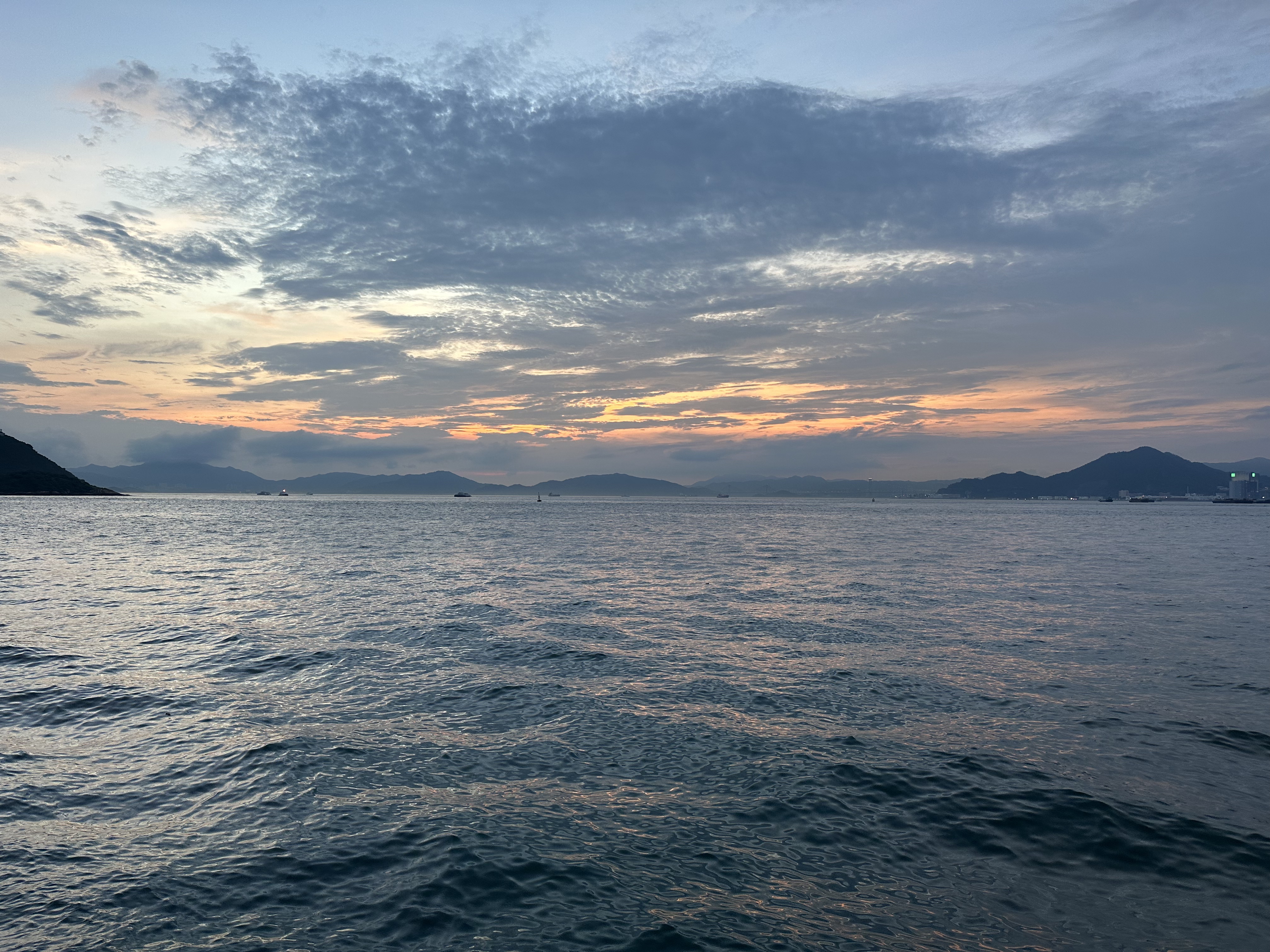
  <img src="/images/posts/2025-07-12/kt1.jpg" alt="Kennedy Town waterfront at dusk." />
  <figcaption>Kennedy Town waterfront, photographed at 19:15 on July 11, 2025 (local time)—at the edge of dusk.</figcaption>
</figure>

<figure>
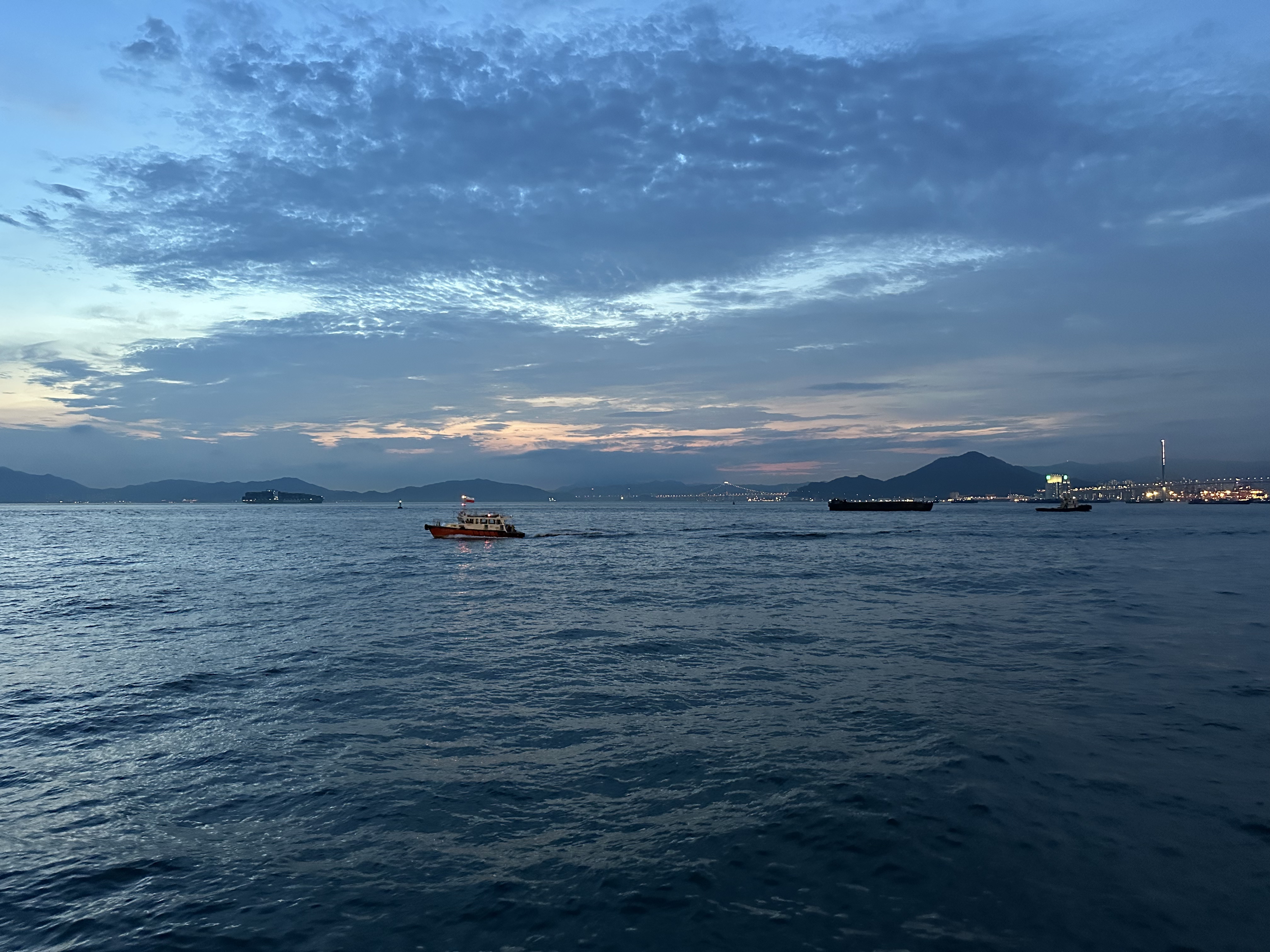
  <img src="/images/posts/2025-07-12/kt2.jpg" alt="Kennedy Town waterfront during the blue hour." />
  <figcaption>Kennedy Town waterfront, photographed at 19:31 on July 11, 2025 (local time)—during the blue hour.</figcaption>
</figure>

<figure>
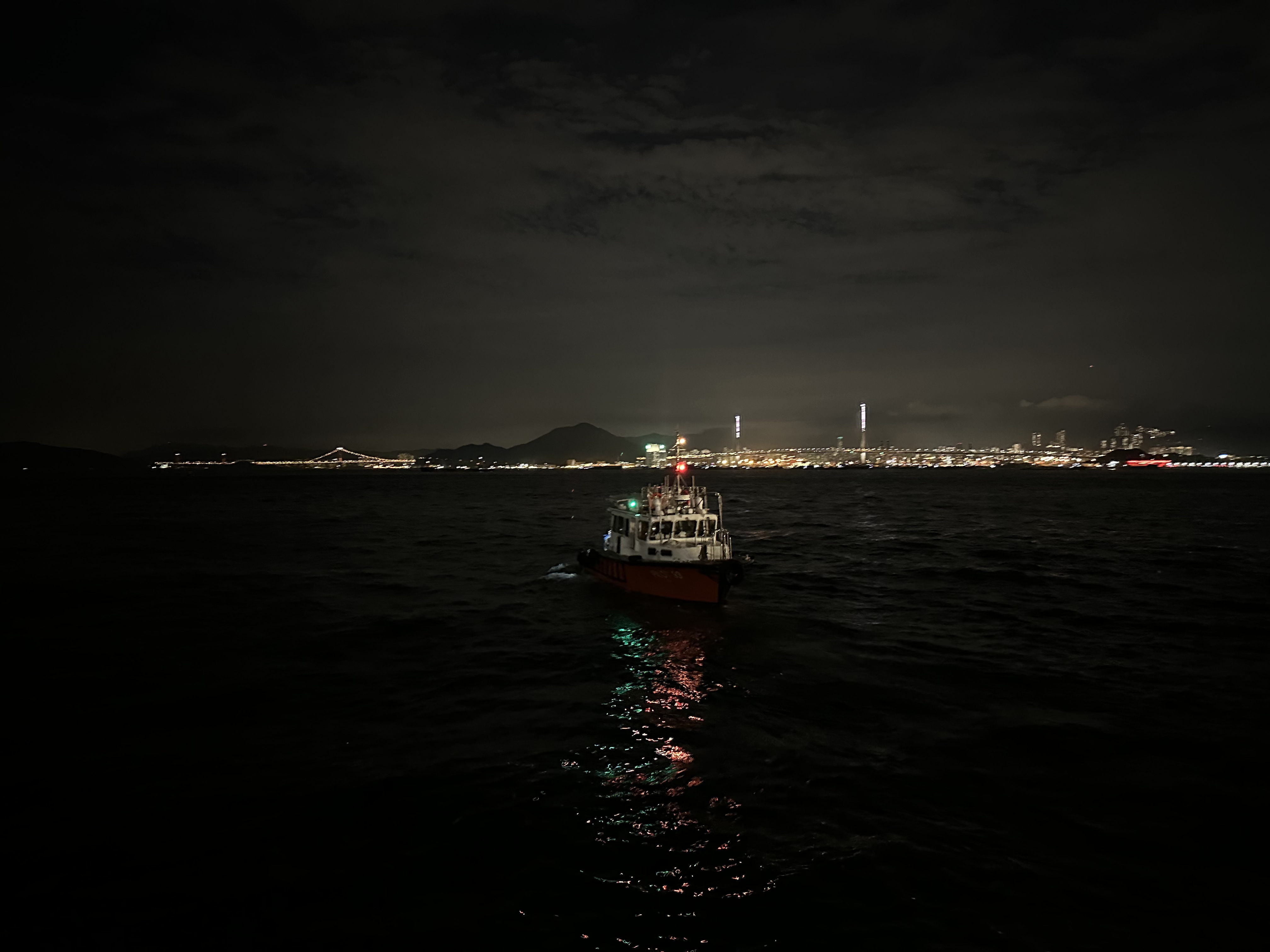
  <img src="/images/posts/2025-07-12/kt3.jpg" alt="Boats moored at Kennedy Town waterfront at night." />
  <figcaption>Kennedy Town waterfront, photographed at 20:10 on July 11, 2025 (local time). I love watching the boats moored here at night—they feel, in some way, like me.</figcaption>
</figure>

<hr />

<h2 id="english-version">The Freedom of Losing Shape: Between the Tide and the River</h2>

<p>A year ago today was my twenty-fourth birthday. Back then, I was still living in Kennedy Town, Hong Kong. My place sat halfway up the slope; walk downhill, and the sea came into view. The promenade along New Praya Harbour witnessed nearly all my solitary hours in the city. When I was just beginning to find my way in the world, confronted with the alienation of my surroundings, I fell into more than one existential crisis. It was this stretch of sea that took me in—deep and reticent—allowing me, on countless nights, to come here and withdraw from the world for a while. When waves that ought to be free kept washing up the stone steps, each surge came again and again; the sound was not violent, yet it was steady and patient, like a reply that asked no reason. And as I tried to take water apart in my mind, I found myself asking what shape I, too, was meant to take.</p>

<p>Over the past year, I moved from Hong Kong to Wuhan. Leaving South China for the heartland, the constant was that I remained thousands of miles from my northeastern home. Study, work, the cadence of everyday life—all had to be recalibrated by choice. Food, climate, habits, and regional culture: everything demanded reacquaintance. The shift in personal identity and in the social world I moved within set new expectations for how I met others and carried myself. Yet when the darkest hours of emotion arrived, I no longer had a sea within arm’s reach. Here, the Yangtze and the Han converge and mingle; I could only be carried forward with them.</p>

<p>The transformation of this year has been immense. Passing through different environments, touching many different fields, I have still been fortunate—luxuriously so—to keep satisfying my curiosity about the cosmos and about science. I have been sustained by the trust and support of mentors and those who have looked after me, and by the steadfast help of family and friends. The year has not been squandered; my troubles have been neither too few nor too many, and in that balance I have, in a sense, won a measure of freedom. While my peers set themselves up in careers, I still want to venture into a wider world—because the world’s plurality is genuinely enthralling, and the unknown, though exhausting, is also full of surprise. Standing again by the Yangtze, it occurs to me that water’s freedom may lie precisely in its willingness to lose its shape: all great rivers have wound and turned, yet none has ever forgotten the direction of the sea.</p>

<p>Today I am lucky enough to return once more to the waterfront and pause. This old acquaintance still offers lively waves to ease my mind. Do not ask where I am going. In the mist, the countless lights across the Kowloon Peninsula bloom into a warm glow that quiets the heart; waves pat the boats moored for the moment, sounding the reverberation of the ocean’s tides—she says: set out, in the bearing of a river.</p>

<p><a href="#top">Back to top</a></p>]]></content><author><name>Ruo-Yu Guan (关若禹)</name><email>ruoyuguan.physics@gmail.com</email></author><category term="essay" /><category term="philosophy" /><category term="life" /><summary type="html"><![CDATA[TL;DR: From the sea in Kennedy Town to the confluence of the Yangtze and Han in Wuhan, I’ve moved through solitude, rupture, and adaptation. Back by the ocean, I realize that water is free because it can forgo its shape—and I, too, will set out again in a river’s posture, still drawn toward the sea.]]></summary></entry></feed>